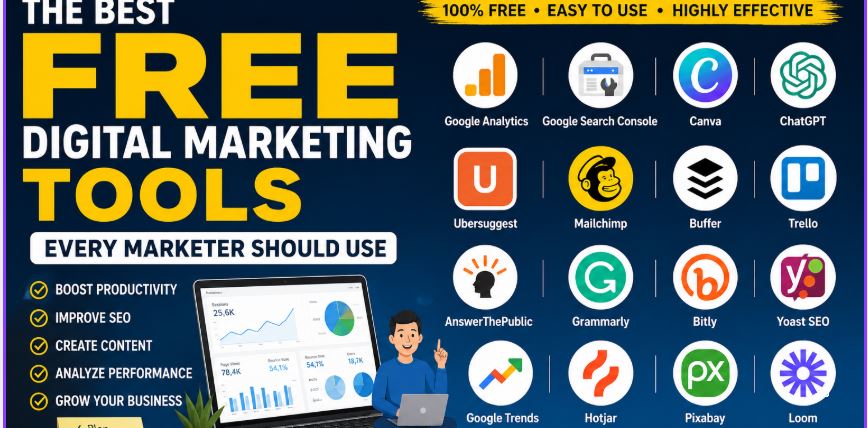
Digital marketing has become one of the most powerful ways to grow a business, build a brand, and reach customers worldwide. Whether you are a business owner, freelancer, blogger, content creator, or marketing professional, having the right digital marketing tools can make a huge difference in your success.
In this blog post, we will explore the best free digital marketing tools every marketer should use. These tools can help you save time, improve performance, and achieve better marketing results without stretching your budget.
Why Free Digital Marketing Tools Matter
Many businesses, especially startups and small businesses, operate with limited marketing budgets. Free tools provide access to powerful capabilities that were once available only to large corporations.
Benefits of using free digital marketing tools include:
- Lower marketing costs
- Improved productivity
- Better campaign performance
- Easier content creation
- Enhanced SEO efforts
- Improved customer engagement
- Better analytics and reporting
The key is choosing the right tools for your specific marketing goals.
1. Google Analytics
Best for Website Traffic Analysis
Google Analytics remains one of the most important free tools available to marketers.
It helps you understand the following:
- Who visits your website?
- Where visitors come from
- Which pages perform best?
- User behaviour patterns
- Conversion rates
- Audience demographics
By understanding visitor behaviour, you can make better decisions about content, advertising, and website improvements.
Key Features
- Real-time visitor tracking
- Audience insights
- Traffic source reports
- Conversion tracking
- Goal setting
- Mobile performance monitoring
Google Analytics should be the first tool every marketer installs.
2. Google Search Console
Best for SEO Monitoring
If you want your website to rank on search engines, Google Search Console is essential.
It helps you monitor your website’s visibility in Google search results.
What You Can Do
- Track keyword rankings
- Submit sitemaps
- Monitor indexing status
- Fix website errors.
- Improve search performance
- Analyse click-through rates.
Search Console gives direct insight into how Google views your website.
3. Google Keyword Planner
Best for Keyword Research
Keywords are the foundation of SEO and content marketing.
Google Keyword Planner helps marketers discover:
- Search volume
- Keyword competition
- Related search terms
- New content opportunities
Even though it was created for advertisers, it remains one of the most useful free keyword research tools available.
Benefits
- Free keyword ideas
- Search trend analysis
- Local keyword targeting
- Content planning support
4. Canva
Best for Graphic Design
Visual content attracts attention faster than text alone.
Canva allows marketers to create professional-looking graphics without design experience.
Create
- Social media posts
- Blog graphics
- Presentations
- Advertisements
- Infographics
- Logos
Its drag-and-drop editor makes designing simple and fast.
Why Marketers Love Canva
- Thousands of templates
- Easy customisation
- Free stock images
- Brand kit options
- Collaboration features
5. ChatGPT
Best for Content Creation
Content remains one of the strongest digital marketing strategies.
ChatGPT can help generate:
- Blog post ideas
- Content outlines
- Email drafts
- Product descriptions
- Social media captions
- Marketing strategies
While human editing is still important, ChatGPT can significantly reduce content creation time.
Advantages
- Faster brainstorming
- Content planning support
- Improved productivity
- Writer’s block solutions
6. Ubersuggest
Best for SEO Research
Ubersuggest is a powerful SEO platform offering several free features.
Marketers can use it to:
- Discover keywords
- Analyse competitors.
- Track rankings
- Find content opportunities
- Audit websites
Key Benefits
- Easy-to-understand interface
- SEO recommendations
- Backlink analysis
- Traffic estimates
It’s an excellent starting point for SEO beginners. 7. AnswerThePublic
Best for Content Ideas
One of the biggest challenges in digital marketing is finding topics people actually search for.
AnswerThePublic solves this problem by generating real search queries.
It Shows
- Questions people ask
- Common concerns
- Search phrases
- Content opportunities
This information helps marketers create highly targeted content.
8. Grammarly
Best for Writing Improvement
Even great content can lose credibility if it contains grammatical mistakes.
Grammarly helps improve the following:
- Grammar
- Punctuation
- Clarity
- Readability
- Tone
Why It Matters
Professional writing increases trust and engagement.
Marketers who publish polished content often achieve better results.
9. Buffer
Best for Social Media Scheduling
Managing multiple social media accounts can be overwhelming.
Buffer helps schedule posts across platforms.
Features
- Content scheduling
- Post-planning
- Performance tracking
- Social media management
Using Buffer saves time and improves consistency.
10. Meta Business Suite
Best for Facebook and Instagram marketing
Businesses using Facebook and Instagram should take advantage of Meta Business Suite.
Benefits
- Schedule posts
- Manage messages
- Track performance
- Analyse engagement.
It provides a centralised dashboard for social media management.
11. Mailchimp
Best for Email Marketing
Email marketing continues to generate one of the highest returns on investment in digital marketing.
Mailchimp offers free features that help marketers.
- Build email lists
- Design campaigns
- Send newsletters
- Analyse performance.
Advantages
- User-friendly interface
- Professional templates
- Automation features
- Audience segmentation
12. Trello
Best for Project Management
Successful marketing campaigns require organisation.
Trello helps teams manage projects through visual boards.
Use Trello for
- Content calendars
- Campaign planning
- Team collaboration
- Workflow management
It keeps marketing projects organised and on schedule.
13. HubSpot CRM
Best for Customer Relationship Management
Managing leads effectively is crucial for business growth.
HubSpot CRM offers free tools for:
- Contact management
- Lead tracking
- Sales pipeline monitoring
- Customer communication
The platform helps marketers nurture leads and improve conversions.
14. Bitly
Best for Link Management
Long URLs can look unattractive and difficult to share.
Bitly allows marketers to:
- Shorten links
- Track clicks
- Monitor campaign performance
It is especially useful for social media marketing.
15. Google Trends
Best for Market Research
Google Trends reveals what people are searching for right now.
Marketers use it to:
- Discover trending topics
- Compare keywords
- Track seasonal interest
- Identify emerging opportunities
It helps create content that aligns with current audience interests.
16. Hotjar
Best for User Behaviour Analysis
Understanding how visitors interact with your website is essential.
Hotjar provides:
- Heatmaps
- Visitor recordings
- User feedback tools
These insights help improve user experience and conversion rates.
17. Yoast SEO
Best for WordPress SEO
For WordPress users, Yoast SEO is one of the most valuable free plugins.
Features
- On-page SEO analysis
- Meta description optimisation
- Readability checks
- XML sitemap generation
It simplifies SEO for beginners and experts alike.
18. Pixabay
Best for Free Images
Visual content improves engagement significantly.
Pixabay offers free:
- Photos
- Illustrations
- Videos
- Graphics
These resources can enhance blog posts and social media content.
19. Loom
Best for Video Communication
Video marketing continues to grow rapidly.
Loom allows users to:
- Record screen videos.
- Create tutorials
- Share presentations
- Communicate with teams
Video content often drives higher engagement than text alone.
20. Google Business Profile
Best for Local Marketing
Local businesses should never ignore Google Business Profile.
It helps businesses:
- Appear in local searches
- Collect reviews
- Share updates
- Improve local visibility
For local SEO, this tool is essential.
How to Choose the Right Digital Marketing Tools
Not every marketer needs every tool.
Choose based on your goals.
For SEO
Use:
- Google Search Console
- Google Keyword Planner
- Ubersuggest
- Yoast SEO
For Content Marketing
Use:
- ChatGPT
- Grammarly
- Canva
- AnswerThePublic
For Social Media
Use:
- Buffer
- Canva
- Meta Business Suite
For Analytics
Use:
- Google Analytics
- Hotjar
For Email Marketing
Use:
- Mailchimp
The best approach is to build a tool stack that matches your business needs.
Common Mistakes Marketers Make When Using Tools
Using Too Many Tools
More tools do not always mean better results.
Focus on a few that deliver the most value.
Ignoring Analytics
Data should guide marketing decisions.
Not Learning the Tools Properly
Take time to understand each platform.
Relying Only on Automation
Automation helps, but human creativity remains essential.
Conclusion
Digital marketing success is no longer reserved for companies with massive budgets. Today, marketers have access to powerful free tools that can help them compete, grow, and succeed online.
When used correctly, these free digital marketing tools can become powerful assets that drive traffic, generate leads, build brand awareness, and help your business achieve long-term success.